
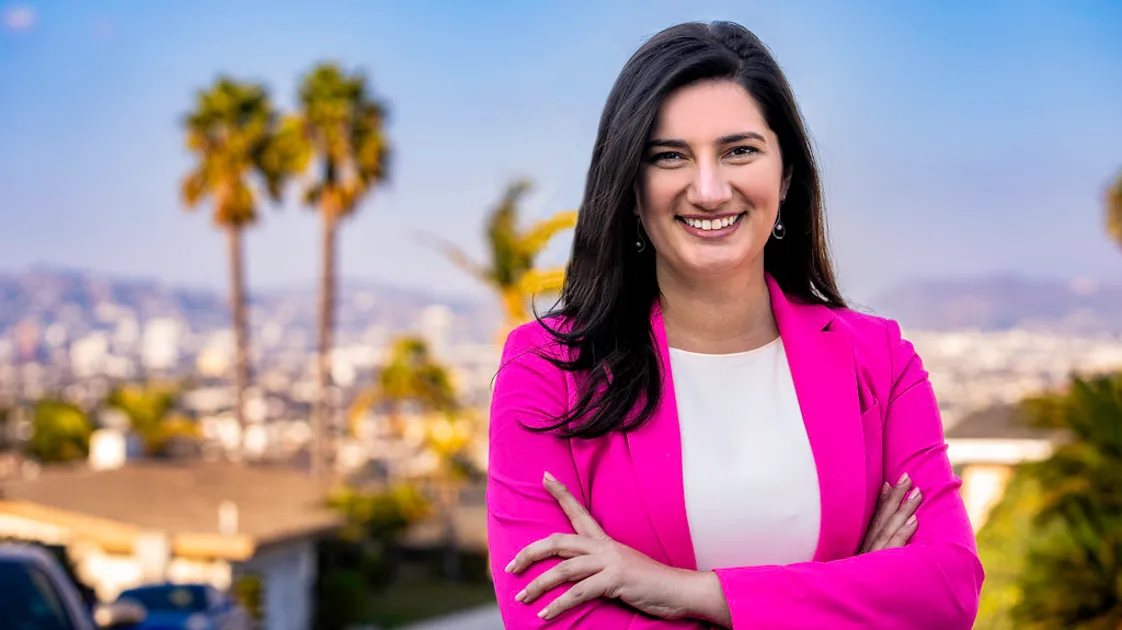
Most voters don’t know who their city attorney is — or even what that person does. It is “one of the most important, but often least understood, positions in the city,” according to LA City Attorney candidate Marissa Roy.
Read more Conservative Texas Voter Gets A Blunt Fact-Check From His Wife During TV Interview
In LA, the city attorney’s job is to prosecute misdemeanor offenses and to act as the lawyer for the city — representing the city when it is sued, advising departments, and writing ordinances at the direction of the city council.
“But the city attorney is also the attorney for the people,” Roy said. “It has the extraordinary power under state law to sue any business for anything unlawful, unfair or deceptive.”
Roy, a Democratic Socialists of America member and a current attorney in the consumer protection section of the California Department of Justice, says the city attorney’s office in the nation’s second most populous city is an untapped resource to lead the legal fight against the Trump administration and to protect working-class Angelenos.
As outside counsel for LA County during President Donald Trump’s first term, Roy worked on cases to protect sanctuary cities and DACA recipients. Days before she started her leave of absence to focus on the campaign, she helped wrap up a case that resulted in more than half a million dollars going back to tenants whose landlord was accused of carrying out unlawful evictions, illegal rent hikes and maintaining uninhabitable units.
Roy is running to unseat incumbent Hydee Feldstein Soto, who has been accused of surveilling and retaliating against her employees, blocking affordable housing, and using her power to try to lift restrictions on police officers using force against journalists. Feldstein Soto is also facing challenges from Deputy District Attorney John McKinney and human rights lawyer Aida Ashouri.
Roy spoke with HuffPost about how she would use the city attorney’s office to take on slumlords, wage-stealing employers and the Trump administration — including the ICE officers who have been terrorizing the city since last year.
This interview has been lightly edited and condensed.
You’ve clearly had an interest in this office for a long time. You spent a year in the city attorney’s office after law school. Four years ago, you wrote a piece for KNOCK LA called “Our City Is Consumed by Corruption. We Need a City Attorney Who Will Clean It Up,” which was in support of civil rights attorney Faisal Gill, who did not win that year. What made you decide to jump in the race this year?
I’ve always believed in the potential of the city attorney’s office, because I’ve seen it and been part of it firsthand. When I got my start at the LA City Attorney’s Office, I helped build out wage theft cases that returned tens of thousands of dollars back to workers. I know that this office can do so much for working-class Angelenos.
With this current administration, in particular, I have been heartbroken to watch it be abused. To see a city attorney using that office to target journalists and protesters, to block affordable housing and to retaliate against her own employees, and surveil their emails. It was really watching the abuses of this office pile up, one after the other after the other, that made me start really thinking about jumping in now — which was a really difficult decision, because I love my current job so much, and have been so content to volunteer and help others run for office.
I also know that in this moment, we need a city attorney with a very specific expertise. Someone who knows how to sue the Trump administration, and someone who knows how to fight corporate abuse — because right now, the federal government is not taking that mantle, and so it really does fall to the city to enforce against corporate abuse.
You mentioned seeing City Attorney Hydee Feldstein Soto target journalists and protesters, blocking affordable housing, retaliating against employees — are there specific instances that have particularly alarmed you?
On targeting journalists and protesters — very early on in her tenure, a journalist was provided with public records pursuant to a lawful Public Records Act request that was court ordered. The city produced too many records, some that should have been confidential — but then sued the journalist for possessing those records, which were just records that were given to him. This was a completely meritless lawsuit, and eventually the city had to actually pay $300,000 to that journalist in attorney’s fees for this misguided lawsuit.
[Feldstein Soto said in an email that “some of the records were released inadvertently or otherwise released through a process the City believed was improper and jeopardized the safety of the LAPD officers, including undercover officers whose photographs were mistakenly included,” and that “decisions to settle a case or pay attorneys fees reflect a weighing of legal risk and cost to taxpayers, not a concession that the underlying position was wrong.”]
An example of blocking affordable housing: The city attorney blocked the Venice Dell project, which was an all-affordable housing project that was slated to break ground on a city-owned parking lot. It had gone through 16 to 18 public meetings. It had been approved twice by [the city] council. But the city attorney . And when she was elected, she did. This project would have created 120 all-affordable units, doubled the parking, added canal access.
There is $42 million set aside from the state to build it, $3 million now from the county — and instead, she has spent over a million in taxpayer dollars to fight this against three lawsuits, where she’s been losing at every single stage in court. So the taxpayer has lost over a million dollars, while $45 million is on the table to build much-needed affordable housing in Los Angeles.
[Feldstein Soto said she “did NOT kill the project but instead successfully defended the City in litigation from every quarter including from both detractors and proponents of the Venice Dell project. She added that the project had “many issues and red flags for corruption,” including “faulty valuation and appraisal” and an “explosive increase in costs.”]
Retaliating and surveilling employee emails: that’s been reported in the LA Times. After the head of the criminal branch raised concerns that the city attorney was targeting political adversaries for prosecution, the city attorney responded by firing the head of the criminal branch. And then another whistleblower raised concerns that the city attorney was using technology to read employee emails.
[Feldstein Soto said she “implemented best practices and shuttered avenues to corruption inside the office.” She added that she “reorganized the office for accountability and compliance,” and “will defend the integrity of the reforms I have implemented every day that I have been in office.”]
With some of these ongoing lawsuits, where would that leave you? On day one, if you become city attorney, is the Venice Dell project dead? Or is that something that could be resurrected?
It absolutely is. Right now, it’s only dead because of the current city attorney’s obstruction. And again, it is costing us, in three lawsuits now, well over a million dollars. So my goal would be to follow the directive of city council and the Coastal Commission — which have approved this project — follow our obligations to see the project through, and hopefully then that would resolve those lawsuits.
You’ve said that as city attorney, you would be on the front lines of the fight against the Trump administration’s immigration enforcement agenda, which has uniquely impacted Los Angeles. You have said you would be “bringing our fight directly into court ourselves rather than hiding behind other parties’ lawsuits, like the incumbent.” Can you elaborate on what the incumbent’s approach has been and how yours would differ?
One of the first things that Trump did was an executive order to ban birthright citizenship. Immediately, the California Department of Justice and the city and county of San Francisco sued. The City of Los Angeles didn’t join that lawsuit — didn’t even join an amicus brief.
Fast forward to June of 2025. Trump federalizes the National Guard and sends them into the streets of Los Angeles. The city attorney of Los Angeles did not file the lawsuit. The California Department of Justice did. It took a in July by the city council to direct the city attorney to the ACLU and Public Counsel’s against ICE for racial profiling.
Was that Vasquez Perdomo?
Yes. By that point, the ACLU and Public Counsel had already done all the necessary work to gain a [].
There is so much litigation necessary against the Trump administration right now. They are left and right doing things that are blatantly unconstitutional and illegal, and all of these government law offices are stretched to their max.
I would also make sure that we are prosecuting rogue ICE agents. We have been reminded by the attorney general that local law enforcement is able to enforce state law against federal officers. I would also be looking at how we use our consumer protection power to sue the companies that are enabling ICE with mass surveillance technology, as well as the companies that are running these private immigration detention centers in unlawful and inhumane conditions.
[Feldstein Soto disputed that she had failed to lead on litigation against the Trump administration. “My Office has filed or joined briefs in more than a dozen cases nationwide including as Amici in the birthright litigation at the Supreme Court,” she said. Los Angeles joined an five months after the birthright citizenship case was petitioned to the Supreme Court.
”As I have often said, ‘If speaking Spanish and looking Latina is enough for reasonable suspicion or probable cause, then we are all at risk, starting with me,’” she continued.]
Read more Uganda Closes Its Border With Congo As Cases Of Rare Ebola Type Surge
What would prosecuting rogue ICE agents look like from the city attorney’s perspective? What misdemeanor offenses would apply here?
I mean, these truly should be felonies, let’s be clear. The off-duty ICE agent who murdered Keith Porter Jr. in Northridge — that should be felony murder. We always have the option, when the district attorney abandons their duty to prosecute, to bring charges as misdemeanors — to use misdemeanor assault charges. I wish there would be more severe charges brought. But if we have a district attorney who is not willing to hold federal ICE agents accountable, then that is an option.
[Greg Risling, a spokesman for Los Angeles District Attorney Nathan Hochman, told HuffPost that the DA’s office had not been presented with a case and that LAPD is still investigating Porter Jr.’s death.]
“Lawyers are great at building the legal theories of litigating the case, but it’s the people on the ground who know their experiences, who can document and provide all of the fact-finding that’s necessary for us to build the case.”
– Los Angeles City Attorney candidate Marissa Roy
Tenants’ rights are a core part of your campaign platform. You noted on your website that as of 2024, of the 13,000 complaints of tenant harassment, only four fines had been issued. You’ve pledged to start a tenants rights team “dedicated to fighting abusive landlords who are evicting tenants under false premises, scamming people out of their security deposits, refusing to repair uninhabitable conditions, and harassing tenants.” What would that look like in practice?
Well, actually, it’s 23,000 complaints of tenant harassment now — and those four citations are for one landlord. It’s a complete dereliction of duty. And it’s a political choice. The city attorney could be doing this work and is deciding not to.
So the tenants rights unit that I want to start would have dedicated attorneys that are working on a range of issues: suing if landlords are violating our tenant anti-harassment ordinance, suing for unlawful evictions, suing for anti-competitive practices like price fixing and rent-fixing, as well as suing for illegal fees, withheld security deposits — the range of things that landlords do that negatively impact tenants and are illegal.
The way that we find these cases has to be always working with community. I’m really proud that every single case I have ever brought has been in coalition with community. I think so often the city attorney’s office feels very far away from us. But it is an office that should serve the people, so we need to build cases with the people. That means partnering with tenants rights organizations, tenants unions, canvassing tenants.
One of the best examples of this partnership that I have seen was — DSA has a very strong tenants organizing arm. They canvass buildings, they’re doing surveys and collecting such valuable data — that goes nowhere. In D.C., the attorney general actually partnered with DSA. DSA canvassed the buildings, got the surveys, asked the questions that were needed to help build the case, and turned over that data to the D.C. attorney general, who sued and won $41 million. That was the judgment against the landlord.
That is how I want to do this work: Leverage the incredible organizing that grassroots organizations and tenant unions have already been engaging in to build those into cases.
Lawyers are great at building the legal theories of litigating the case, but it’s the people on the ground who know their experiences, who can document and provide all of the fact-finding that’s necessary for us to build the case.
[Feldstein Soto said that her office acts on referrals from the Los Angeles Housing Department “that meet the evidentiary standards required for prosecution or administrative citation.“The LA Times reported in January that 30 cases had been referred to the city attorney for potential criminal cases. The city attorney’s office has issued 18 citations and filed 2 criminal misdemeanor cases, Feldstein Soto said.
“I recognize the gap between volume of complaints and volume of enforcement actions, and my Office has taken concrete steps to work closely with LAHD to close that gap,” she continued, citing the hiring of a tenant rights community activist and tenant anti-harassment lawyer.]
Similar question with wage theft: What does it look like to go out and find examples, and how do you go about holding violators accountable?
It stems from the same theme of working with community organizations. My first case at the city attorney’s office was fighting the misclassification of truck drivers down at the Port of Los Angeles. I first read about this issue in USA Today, and I started investigating it the way that I have been taught in law school, which is looking at all the public databases and trying to research that way.
It wasn’t until we got connected with LAANE — the LA Alliance for a New Economy — and the Teamsters that they were able to provide thousands of boxes of documents. They knew the worst offenders at the port. They were the ones who had the trusted relationships with workers, so that workers could trust us in an interview. That lit the fire under our case and allowed us to build a really strong complaint that was ready for filing.
My favorite case I worked on in my entire career was a case against two car washes in the Silver Lake area that were paying undocumented workers as little as $4.50 an hour. Those workers, of course, knew that their rights were being violated, but were getting threatened with immigration consequences. And the thing that is so special about litigation brought by the city attorney is no one has to put their name on the lawsuit. It’s brought in the name of the people of the state of California. So it offers workers critical anonymity. We actually built that case with CLEAN Carwash, which is a workers rights center. We built this case with them providing so many of the facts that they have been documenting for years. And that case settled within less than a year, and provided workers with $10,000-$40,000 each in back pay.
The Los Angeles Police Department has repeatedly been sued over its use of crowd control weapons during protests. Last year, Feldstein Soto filed a motion asking a federal judge to lift restrictions on LAPD’s use of force against journalists. She that request after the city council unanimously voted to direct her to do so. How would you handle this issue if you were city attorney and it became your job to defend these cases? In that case, is it your job to defend whatever LAPD does?
I often say that the best way to defend a client is to prevent the lawsuit — prevent them from breaking the law in the first place.
Last September, there was a court order that was issued restricting LAPD’s use of less-lethals against journalists for crowd control. And this is not a new issue. This is something that the city had been sued about in 2000, 2007 and 2020 — and have lost every single time. The California State Legislature passed a new law in 2022 restricting the use of force in protest situations. And still, that injunction was issued because of violations by LAPD.
Now, right before the No Kings protest in mid-October, the city attorney tried to lift the injunction, and tried to defend this move by saying that the injunction was unclear or ambiguous or too broad. But as any good litigator would know, there are options like motioning to modify or to clarify an injunction. A motion to lift an injunction is an ask for a free pass, essentially. That not only makes the public less safe, but it sets the city up for future lawsuits. Because that motion was revoked by council, which rebuked the city attorney, and then, without any other advice, the LAPD kept doing what it has been doing before, and is opening us up to more liability exposure.
As city attorney, I would be looking to proactively make sure that we are complying with all federal, state and local civil rights laws. I never want to be sued for the same thing again. I want to make sure we’re taking the corrective action, we’re implementing protocols, and we have appropriate discipline and accountability if someone isn’t following those protocols. It’s the best way to keep the public safe, but it’s also the way to mitigate our exposure to liability, when we’re overspending by hundreds of millions of dollars in liability, and the biggest offender is LAPD.
[Feldstein Soto said she “unequivocally” supports “the first amendment protections for speech, assembly and free press and press access” and has worked with LAPD to provide training. She said the injunction overly broad, redundant of a 2020 injunction already in place and risked creating “confusion.”]
The city attorney only has so much power over the LAPD. What do you do if the law-breaking continues and you keep getting sued for the same thing over and over?
The city attorney’s office has the legal advice function, and through that, we do advise city departments on policies. And then, there’s also an injunction or consent decree. Those are court-ordered policies that the departments don’t have any discretion to disobey, or they can be held in contempt. And contempt can apply to individuals as well as institutions.
I want to ask you about DSA. You’re a DSA member and there’s been a lot of talk in Los Angeles about, “Where is our [New York Mayor] Zohran [Mamdani]?” And I think the gains DSA has made in Los Angeles may be underappreciated. Four of the 15 LA City Council members are DSA members. There are two members who are running for mayor. The current controller is a DSA member. Could you talk a little about your involvement in DSA and how it’s informed your approach to politics and organizing?
DSA’s mission is to build power for the working class, and to make sure that workers and tenants have a voice and are reflected in our policies. I actually think that this is a vision that is shared across so many grassroots organizations, and, I would say, the Democratic Party as well. I have such a broad coalition of unions in support, DSA, the Democratic Party and grassroots organizations, because I really do believe that a lot of these values are universal.
My involvement with DSA — one of the things that I have been really grateful for is how much it has taught me to organize and to think like an organizer. The idea of making sure that everyday people are getting input into the policies that we are advocating for, that is so critical. It has made me think, not just as an attorney, of how I build cases in the public interest, but how we really bring in the lessons of organizing and how we are really reaching people and bringing them into the government process. And I think that’s what you’ve seen DSA bring to the table — just bringing so many more people into governance who haven’t had a voice previously.
Read more ‘Lack Of Candor’: CNN Medical Analyst Has Questions As Trump Heads To Hospital Yet Again




Leave a Reply