
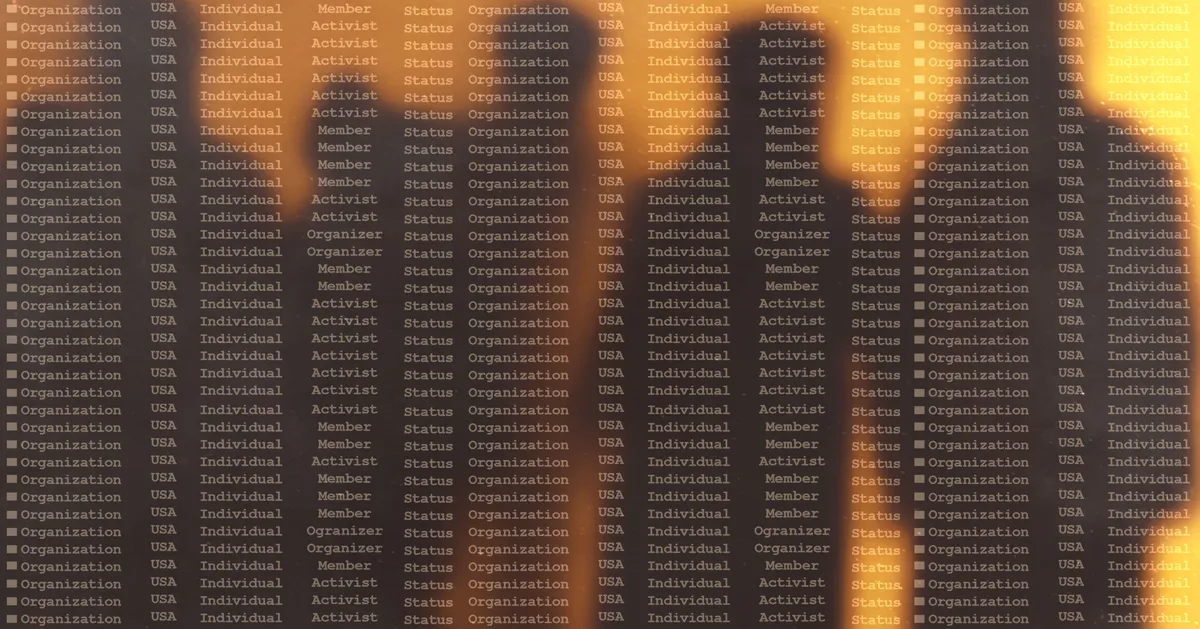
For 20 years, a right-wing think tank has been quietly collecting information on thousands of Muslim individuals and organizations in a vast database.
Read more Reviewers Swear This $15 Sweater Is Soft And Comfy Enough To Rival Cashmere
HuffPost reviewed the database maintained by Middle East Forum, a controversial group that civil rights organizations say has repeatedly spread misinformation about Islam and Muslims, last year. At the time, the database had thousands of entries about Muslim Americans, including such data as names they go by, social media accounts and tax information, as well as thousands of entries about Muslim organizations, including schools, mosques and businesses. The file also included people and organizations MEF has deemed allies to the Muslim community.
After HuffPost inquired about the database and said it planned to publish a story about it, MEF announced Thursday that it will allow scholars, journalists and other researchers to apply for access to the file, which it refers to as the Counter-Islamism Research Clearinghouse.
“We had planned to announce this later in the year,” Gregg Roman, the executive director of MEF, wrote in an email. “HuffPost moved the date, and we are glad of it. The only thing worse than being accused of keeping a file is being accused of keeping it secret, and as of this morning no one can say that.”
MEF was founded in 1994 to “protect Western values from Middle Eastern threats” and “emphasize the danger of lawful Islamism,” according to the organization’s website. The group says its “guiding principle” is that “radical Islam is the problem, and moderate Islam is the solution.” However, civil rights organizations say that for the past three decades, the think tank has been key in spreading Islamophobia in the U.S. through social media posts, policy recommendations, public appearances and by funding organizations with anti-Muslim views. In 2024, MEF brought in more than in revenue.
Mainstream Republicans have increasingly accepted MEF over the years, even working closely with the organization at times. At least one person whom MEF researched has been targeted for deportation by the Trump administration, and more than a dozen Islamic schools were recently removed from a state program due in part to an MEF official sounding the alarm on them.
The information in the database is all available from public records. However, the breadth of the file is remarkable. Although there have been various efforts to track Muslim Americans throughout the years — including several by the U.S. government in the 25 years since 9/11 — there has never been a known database that has been so comprehensive and has included such a vast array of organizations and everyday people.
In total, the archive contains more than 4 million data points, according to MEF.
In a statement, MEF said there was nothing unusual about keeping such data.
“Mapping ideological networks is an ordinary practice in American civil society,” the statement said. “The Anti-Defamation League tracks antisemitic actors. The University of Maryland maintains profiles of more than 3,500 American extremists and gives researchers access by application. Good-government groups publish indexes of donors and lobbyists. We apply the same method to American Islamism. … Our critics keep files on us.”
Yet the existence of a detailed database raises questions — especially at a time when Muslim Americans say Islamophobia is increasingly rising, fueled by President Donald Trump’s war in Iran, his crackdown on pro-Palestinian protesters and a surge of anti-Muslim rhetoric propagated by Republican lawmakers.
Caleb Kieffer, a senior research analyst at the Southern Poverty Law Center, an anti-hate nonprofit, called the existence of the MEF archive “very concerning.”
“The revelation of this database comes at a time when we are seeing an uptick in anti-Muslim fearmongering in the country not only from established hate figures but also elected officials at all levels of government,” he said.
“It’s a target list,” said Mobashra Tazamal, associate director of the Bridge Initiative, a research organization housed at Georgetown University that focuses on research and analysis of Islamophobia and its impact.
“It’s a list that can be handed to the government to surveil, to monitor, to harass, to intimidate organizations and individuals, especially an administration that views Muslims as the enemy or as the threat to America, and views Muslim Americans as the enemy within.”
The Database
Islamist Watch — a program through which MEF tracks organizations and schools, then shares the information with government officials and lawmakers — oversees the database. But MEF uses the file to inform several other projects, the organization said, including Campus Watch, which publishes information about students, professors and faculty across the country, drawing attention to their views about Israel and the Middle East.
The database, which has been maintained since 2006, “is the research base for everything we publish,” Roman told HuffPost.
When HuffPost viewed the database in 2025, readers could see a section showing which entries had recently been updated, as well as when they had been updated and by whom. At that time, the entries in this section were shown to have been updated in late 2023.
Roman called the database “a living research file” that is “updated as the public record changes.”
The database could be filtered in several ways, most notably by tabs labeled “Individuals,” “Organizations” and “Associations.” It contained entries for over 5,500 individuals and 10,600 organizations. MEF did not say how many entries it now contains but pointed to its millions of data points pulled from public records. Entries appeared to track people in 45 countries, but most (over 4,700) were based in the U.S.
Those individuals included some high-profile politicians, including Reps. Ilhan Omar (D-Minn.), Andre Carson (D-Ind.) and Rashida Tlaib (D-Mich.), as well as Minnesota Attorney General Keith Ellison. (Roman confirmed they are all still in the file.)
Some of the people in the database are not Muslim themselves but work in fields related to Islamophobia or have close connections to prominent Muslims. Rep. Alexandria Ocasio-Cortez (D-N.Y.), for example, was in the file with the label “Fellow Traveler,” a term that historically was used to refer to people suspected of sympathizing with the Communist Party. (Roman did not respond to a specific question about the use of the term, but MEF’s statement used it as well: “We also document the fellow travelers: the politicians, academics and activists who legitimize and platform these networks. By tracking who shares a stage with whom and who signs which declaration, we show how a movement is mainstreamed.”)
The database also included figures who are not public servants or those who have large online followings, such as imams at small mosques or Islamic schools, doctors, lawyers, journalists and activists. (This reporter was included in the database. MEF did not respond to a specific question about whether that was still the case but did note: “As for Rowaida Abdelaziz, she is one of several Muslim journalists whose work we have followed, and at times promoted her writings.”)
There was also an “ideology” column, with several options in a drop-down menu. Some of the listed options are broad sects that refer to various schools within Sunni law, while others — such as the term “Radical” — seemed much more vague.
“That field is generated automatically based on an algorithm that considers the record’s various ideological tags,” Roman wrote, in part, when asked about the labeling system. He said MEF monitors “24+ Islamist movements” and that “our database works to understand the enormous diversity of Islam in the West.”
“A label is an assessment of a public record, not an endorsement or an accusation,” he said.
As was the case with individuals, the entries under the “Organizations” tab ran the gamut from the country’s largest Muslim-based nonprofits, including Islamic Relief and the Council on American-Islamic Relations, to much smaller businesses. (Roman confirmed both Islamic Relief and CAIR are still in the database.) Some major organizations that are not primarily focused on Muslim Americans or Islam were also featured, including Oxfam, a global confederation of groups fighting inequality, and the Women’s March, a women’s rights group that formed after Trump was first elected.
Labels identify a wide variety of organizations, including funeral homes, mosques, bookshops, health clinics, law firms and different types of media outlets.
The database listed tax information and 990 forms for several Muslim organizations, what grants they have received and how they used those funds. Employer identification numbers — nine-digit numbers given to businesses by the IRS for tax and banking purposes — were also listed, as were businesses’ precise locations. MEF uses EINs “to follow money between organizations, to audit grants, and to check whether a charity operates within the rules of its status,” Roman said.
The “Associations” tab linked individuals and organizations by identifying people affiliated with certain organizations and their roles, such as board members. “Islamism in America runs through overlapping organizations, and mapping the links is the research,” Roman said.
This section also identified members of Students for Justice in Palestine, a student activist group with hundreds of chapters across universities that has been targeted by Trump and far-right organizations, predominantly during the 2024 spring semester.
There was also a section in the database that listed upcoming events connected to the people or organizations being tracked. “We use event records to document speakers with histories of praising terrorism or inciting hatred against minorities, to report on lobbying and foreign agent activities, and to alert venues, sponsors, and officials when a scheduled speaker has such a record,” Roman said. “We attend public events, sometimes without announcing who we work for, as investigative reporters do. We do not surveil private life.”
Targeted For Deportation
After the Oct. 7, 2023, Hamas attacks and the subsequent bombardment of Gaza by Israeli forces, the Trump administration launched a chilling surveillance campaign at home with the help of organizations like MEF. In particular, the administration targeted students who spoke out against the war.
In March 2025, MEF published a dossier on Badar Khan Suri, a postdoctoral scholar affiliated with the Bridge Initiative and a professor at Georgetown University, that included links to his social media posts critical of Israel and noted that his father-in-law had previously served as a Hamas adviser. The next month, Suri was arrested and targeted for deportation by the Trump administration.
In a post on X in March 2025, MEF founder Daniel Pipes credited someone from his organization for unveiling that Suri “actively spreads [Hamas] propaganda.”
“Thanks to her work, [DHS] arrested Suri and plans to deport him,” Pipes wrote. “MEF—‘a think and action tank.’”
Suri’s lawyers said his detention was “punitive” and a retaliatory measure for his advocacy on Gaza. He was released from detention last May after a judge ruled that the government had failed to provide any evidence for its claims that Suri had ties to Hamas, but his deportation case is ongoing. “MEF publishes research; it does not make immigration decisions,” Roman wrote in response to questions about the immigration proceedings that took place in the wake of the dossier release.
MEF’s Campus Watch has been heavily criticized for McCarthyist-style scapegoating, with academics and civil rights groups alike noting its dangerous impact on academic freedom.
Juan Cole, a professor at the University of Michigan, was among those targeted by Campus Watch when it first launched in 2002. His name was on a list with those of a dozen other professors and academics who specialized in Middle East studies, he recalled to HuffPost.
The list was accompanied by “a very smarmy kind of text that hinted that we were traitors to the United States in favor of terrorism and so forth,” Cole said. “At that time, it was very difficult to defend oneself from such a thing.”
“It was the beginning of the use of enemy lists and surveillance tactics to marginalize Middle East studies with the subtext of silencing voices that might be critical of Israeli policy,” Cole said, noting that since then, the trend has only become more common and more troubling.
The idea of a database is just as alarming decades later, especially under the Trump administration, Cole said in an interview before MEF publicly acknowledged its file.
“It’s all fascism,” he said. “It’s an attempt to subvert the Constitution in favor of far-right techniques of social control.”
The MEF Influence
Pipes, the founder of MEF, has repeatedly called for intense “scrutiny” of Muslim Americans and their organizations.
In 2016, the SPLC published a “journalist guide” that labeled 15 individuals, including Pipes, as “anti-Muslim extremists.” The guide was meant to assist news outlets in combating the heightened Islamophobic misinformation and conspiracy theories at the time. One of those named individuals, Maajid Nawaz, successfully sued the SPLC for defamation; in 2018, the SPLC issued an apology to Nawaz, paid a financial settlement and removed the guide from its website.
However, the SPLC has maintained that Pipes is an anti-Muslim figure who runs an anti-Muslim organization.
“Daniel has been like a longtime thought leader and a central figure within the Islamophobia organizing movement,” Kieffer, from the SPLC, told HuffPost in an earlier interview. “Middle East Forum is a place for him to push this anti-Muslim rhetoric.”
Tazamal from the Bridge Initiative categorizes MEF “as one of the original organizations focused on demonizing Islam and Muslims.”
“It’s been in existence for a long time,” she said. “It’s a central node, I would say, in disseminating misinformation and disinformation when it comes to Islam and Muslims.”
Roman reiterated to HuffPost that Pipes believes “radical Islam is the problem and moderate Islam is the solution, and the Forum publishes and funds Muslim reformers accordingly.” He cast doubt on the legitimacy of the Bridge Initiative and the SPLC, including by noting the lawsuit over the “journalist guide.”
MEF’s scrutiny of Muslims has had alarming consequences for Muslim civil liberties and religious freedoms.
Officials in Texas excluded more than a dozen Islamic schools from the state’s voucher program last April after several people, including Sam Westrop, the director of MEF’s Islamist Watch, alleged that several Texas Islamic schools had extremist ties.
Westrop published a report about Texas Islamic schools on the MEF website under its Islamist Watch project earlier this year. He later emailed his allegations directly to the state comptroller’s office, which oversees the government program that allows families to access public funds to pay for private education expenses. (Westrop’s influence on the schools being removed from the voucher program was first reported by ProPublica.)
As the director of Islamic Watch, Westrop oversees the database that was announced publicly this week, Roman said.
MEF appeared to take a victory lap after the schools were removed from the program.
“The Middle East Forum’s analyses of Islamism in Texas have sparked wide-ranging political change and amplified media attention on the state over the past year,” the organization said on its website.
Islamic schools and the local Muslim community claimed they suffered as a result of this effort, according to court documents. The accusations “created an atmosphere of fear and danger for students and teachers attending these schools,” and the schools had to hire additional security, alleged a lawsuit filed against state leaders.
In a , Mehdi Cherkaoui, whose kids attend Houston Qur’An Academy Spring, said he was suddenly forced to pay more than $17,000 per year in tuition for his two children — a cost normally covered by the voucher program.
Some of the schools have been readmitted to the program since the lawsuits were filed. The litigation is ongoing.
“Taxpayer money should not fund institutions run by people with documented ties to violent extremist movements, whatever the religion,” Roman said, declining to comment further on pending litigation.
MEF has been gaining influence in mainstream Republican politics for the past several years.
In April 2017, then-Rep. Ron DeSantis (R-Fla.) worked with MEF to launch a caucus of right-wing, pro-Israeli representatives called the Congressional Israel Victory Caucus on Capitol Hill. The group lobbies and advocates for a shift in Israeli policies “not through concessions” with the Palestinians and “to convince Palestinians that the Jewish state will endure.”
Last year, as Florida governor, DeSantis signed an executive order to designate CAIR as a terrorist group, and MEF filed an amicus brief in support of the order. A federal judge has since blocked the enforcement of the executive order.
Also in 2025, then-Rep. Marjorie Taylor Greene (R-Ga.) invited Roman to testify in front of Congress. He did, advocating for the U.S. to pause aid to several Muslim charitable organizations.
The move exemplified how extremist groups like MEF have “broadly enjoyed unprecedented access to officials across the federal government” throughout Trump’s presidency, according to the SPLC.
Cole, the Michigan professor, said MEF’s tactics have not changed over the years — the group still targets those it disagrees with, which can have significant consequences.
“The insidious thing about it is you don’t know,” he said. “You don’t know which of your colleagues might be influenced, or which of your administrators. It’s not like somebody comes to your face and tells you, and you don’t know the opportunity cost. You don’t know what prizes you were turned down for. You don’t know what outside offers didn’t materialize.”
“Nowadays, targeting people is easy. Making lists is easy. Putting out an innuendo about them is easy,” he added. “People shouldn’t be passive. They should fight back.”
Read more 9/11 Widow Delivers Scathing Message About Saudi Arabia During Ground Zero Ceremony


Leave a Reply