
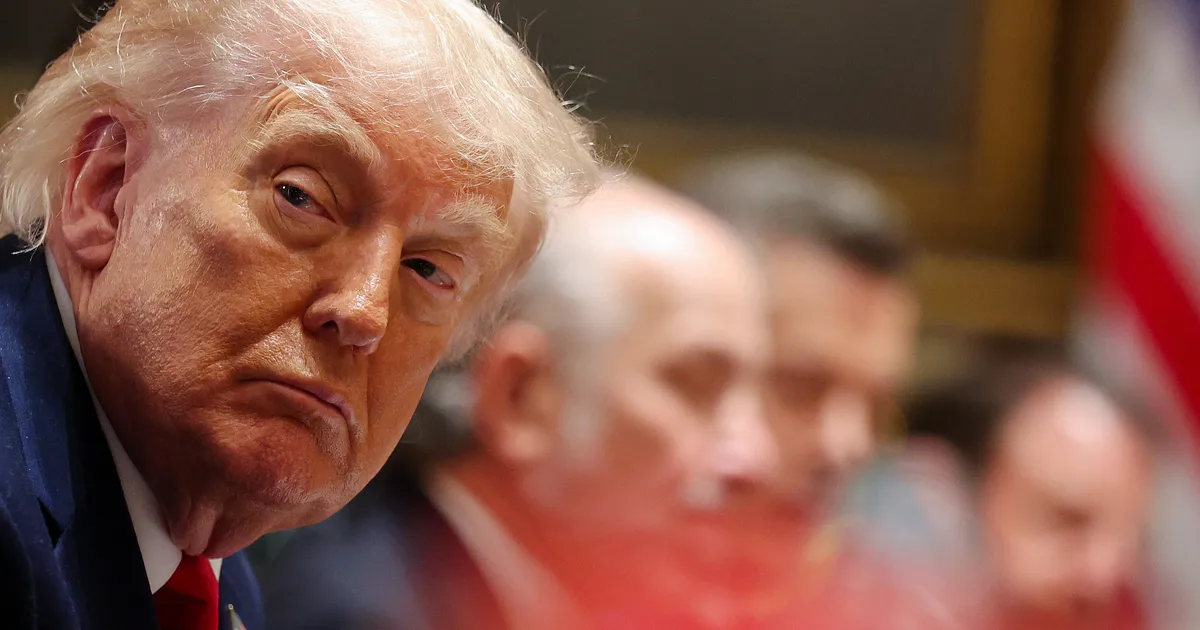
The label “elitist” has followed liberals around like a bad smell for decades. President Donald Trump has repeatedly appealed to working-class voters by casting liberals as the elite, making no secret of his contempt for highly educated coastal types who vote Democrat.
Read more Republican Senator Calls For Donald Trump Jr. Subpoena
Of course, Trump has also asserted that he and his supporters are the real elite — just look at his bank account and real estate portfolio, he’s said.
“We got more money, we got more brains, we got better houses and apartments, we got nicer boats, we’re smarter than they are and they say they’re the elite,” the president said in 2019. “You’re the elite, we’re the elite.”
Voters now seem to agree with him. According to a new poll conducted by The New York Times and Siena University, Americans are more likely to see Republicans than Democrats as “elitist.”
Asked which party they think the word “elitist” describes, 43% of independent voters said Republicans and 33% said Democrats.
It’s a notable shift from when The Times asked the question in 2022: Back then, Republicans and Democrats were nearly tied — 35% for Democrats, 36% for Republicans.
Every age demographic viewed Republicans as more elitist, but especially for 18- to 29-year-olds: 59% for the GOP, compared to 27% for the Democrats.
“Persistent and growing economic worries, especially among the young, who are desperate for a path to prosperity, may have contributed to a change in perception, “ said Alex Priou, a professor of philosophy at the University of Austin in Texas.
One of the most significant factors in the change of perception is the successful election of democratic socialist candidates like New York City Mayor Zohran Mamdani, Priou said.
“These are candidates who speak more directly and offer bigger promises to struggling young people,” he said. “Whether they will deliver is another question. But as an account of the change in perception, it makes some sense.”
Trump actually helped Republicans shake the ‘elitist’ tag. Now, he’s bringing it back.
The association between “elitism” and the Democratic Party came about relatively recently, according to Jacob Neiheisel, an associate professor of political science at the University at Buffalo, The State University of New York.
Beginning in the mid-1950s, political scientists have asked voters about the images of the parties that they hold on the American National Election Study, Neiheisel said. Since the beginning of the long-running survey, others have, on balance, connected the Democratic Party with concepts like the “common man” and the “little guy,” Neiheisel said. Republicans, by contrast, have often been associated with elite institutions.
Trump changed that, ushering in an era of right-wing populism that appealed to working-class voters in part through an “America First” foreign policy and a promise to revive American manufacturing. His pledge to protect popular social safety nets such as Social Security and Medicare only sweetened the deal.
“When Trump first arrived on the scene, blue-collar voters and those with lower levels of education began to gravitate toward the Republican Party,” Neiheisel said.
But in his second term, that populist veneer has slipped: An unpopular war in Iran has undercut his “America First” foreign policy, while his tariff-driven manufacturing revival has produced more manufacturing but not more jobs, according to a recent Economist study. Meanwhile, Trump’s One Big Beautiful Bill Act has cut SNAP funding and made significant funding cuts and policy changes to health care programs, including the Affordable Care Act and Medicare.
At the same time, the administration has pursued tax cuts for the wealthy and deregulation while filling key positions with billionaires. Elon Musk — the one-time head of the so-called DOGE, the Department of Government Efficiency, which was tasked with slashing federal spending and restructuring federal agencies — called Social Security “the biggest Ponzi scheme of all time.”
The estimated $600 million ballroom currently being built at the White House, partially on taxpayers’ dime, and other Trump legacy projects around Washington, D.C., have only added to the administration’s “elitist” reputation.
Now, Republicans are arguing that voters simply need to stick with the party a little longer to see the promised benefits on their end.
Read more Scott Jennings Actually Said 1 Trump Move ‘Wasn’t’ Smart
“There is more work to do, of course, and it will take more time,” Vice President JD Vance said at a campaign stop in North Carolina earlier this week.
Why you don’t want to seem ‘elite’ come election time.
We have an almost visceral aversion to the idea of an elite, Priou said, even when that status is based on real skill, education or political talent. (In other words, even when the label is merited.)
In 2004, Sen. John Kerry’s elitist reputation — his blue-blood family lineage, Yale University degree and later marriage into substantial wealth through Teresa Heinz, heir to the Heinz food empire — was a significant factor in his presidential loss.
“Elite” is code for “not one of us.” And in an election year, that’s not a label any candidate wants attached to them come November.
“[Elections] are a release valve on revolutionary fervor, helping assuage the political passions,” Priou said. “It allows us to assert that, whoever the elite or ‘select’ may be, it is ‘We the People’ who do the selecting.”
Whether we select well is another story.
“The health of a regime depends on whether the people have been educated to appreciate the virtues good rule requires, sufficiently for their role as the electorate,” he said. “I don’t think that sort of education is very common these days. Our politics is worse for it.”
‘Elite’ has two different meanings in America today ― but there’s one definition we can all agree on.
What “elite” means can differ depending on who you ask. There’s the economic view, often perceived from the left, entailing the mega-rich, corporate CEOs, and top-tier bankers who control vast resources and influence public policy.
Then, there’s the cultural and educational view of the “elite,” often viewed from the right.
“For some conservatives, ‘elite’ is identified with elements of what they sometimes talk about as ‘the Cathedral,’” Neiheisel said, which includes legacy media as well as universities and the bureaucracy.
But there’s a definition of elite that all sides can agree on, according to Nicholas Tampio, a political science professor at Fordham University in New York City.
“An elite is somebody who has, in effect, more than one vote,” he said. “One can have more than one vote by being able to make a major contribution to a political candidate or party, by having special knowledge and credentials to navigate the legal system, or by having access to media networks.”
Trump is right that Democrats have elites, including wealthy liberal donors, law professors and talking heads, Tampio said. But it is also true that the Republicans have elites, and Trump has filled his cabinet with billionaires and military generals.
“The Epstein scandal has convinced people that Trump and his friends can get away with crimes because of their money and connections,” he said. “That is why people feel, correctly, that Trump is an elitist who holds himself and his family above the law.”
Whatever definition of “elite” you subscribe to, it’s in Americans’ DNA to want to distance themselves from the label: As Tampio noted, in “Democracy in America,” the French philosopher Alexis de Tocqueville observed that the U.S. differed from Europe in that it lacked an aristocracy — an image of ourselves Americans have been reluctant to let go of.
“America was the place where nobody acted like they were better than anybody else,” Tampio said. “That is why the country does not have titles of nobility, and even tech billionaires wear hoodies to show that they are not too different from ordinary folk.”
Without even wading into policy matters, Trump is breaking tradition on optics alone, from creating an Old World-style ballroom in the White House to traveling with a sprawling entourage.
“He is acting like a king surrounded by vassals, which means that he views ordinary people as serfs,” Tampio said. “Maybe people could tolerate that attitude when gas and food were cheap, but now that the cost of living is rising faster than wages, I think people have had enough of Trump’s faux monarchy.”
Read more 2 Jan. 6 Officers Question Democrat’s Decision To Feature Rally Attendee


Leave a Reply