
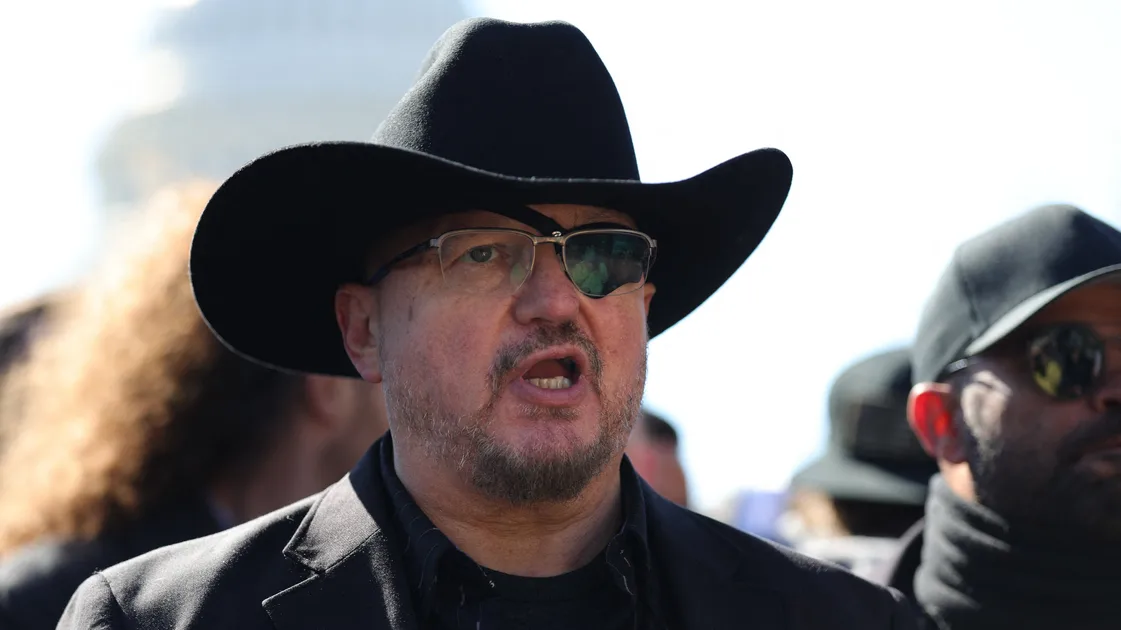
A federal judge granted the Justice Department’s request to dismiss the case against the leader and some members of a far-right group involved in the Jan. 6, 2021, riot at the U.S. Capitol — but he made clear he wasn’t happy about doing so.
Read more National Guard’s Deployment To D.C. Until 2029 Will Cost $1.4 Billion, DOD Says
“Reluctantly, the court grants the motion,” U.S District Judge Amit. P Mehta wrote in his .
Oath Keepers founder Stewart Rhodes and several other members of his right-wing militia had previously been convicted for their roles in the insurrection. Mehta had sentenced Rhodes, who was convicted of seditious conspiracy, to 18 years in prison. The founder and his allies were among the few Jan. 6 defendants who did not receive a full pardon from President Donald Trump on the first day of his second term, though Rhodes did have his sentence commuted at the time.
“Today’s epilogue diminishes the gravity of that day, denigrates the work of the prosecutors and law enforcement officers who secured these convictions, and excuses criminal acts that caused a centuries-long pillar of our democracy — the peaceful transfer of presidential power — to buckle,” wrote Mehta.
The judge clarified in his ruling that he lacked the authority to deny the prosecutor’s request to dismiss Rhodes’ case, stating, “The court cannot write a different ending.”
“If it is their view that the public interest is served by surrendering convictions for crimes against the country to the gloss of an enduring public record, then that is an assessment to which this court must yield,” Mehta wrote.
Read more The Products Doctors Used To Handle Their Menopause Symptoms
He noted the Justice Department did “not say that the charges were legally deficient or that the evidence presented is insufficient to sustain Defendants’ convictions,” nor did they identify any legal error that resulted in an unfair trial or a wrongful conviction.
“Remarkably, then, the government does not maintain that dismissal is in the public interest to rectify a fundamental error or a grave injustice. Its lead argument is rather that dismissal is appropriate to protect Defendants from harassment,” Mehta wrote.
The judge, who was appointed by President Barack Obama, also said the Justice Department gave Rhodes and his allies “unearned grace by wiping their records clean.”
“This is the last of the prosecutions seeking to hold accountable those responsible for the events of January 6,” Mehta wrote. “That book is now closed.”
Read more Status Of U.S.-Iran Talks Uncertain As Ship Struck In Strait Of Hormuz






Leave a Reply