
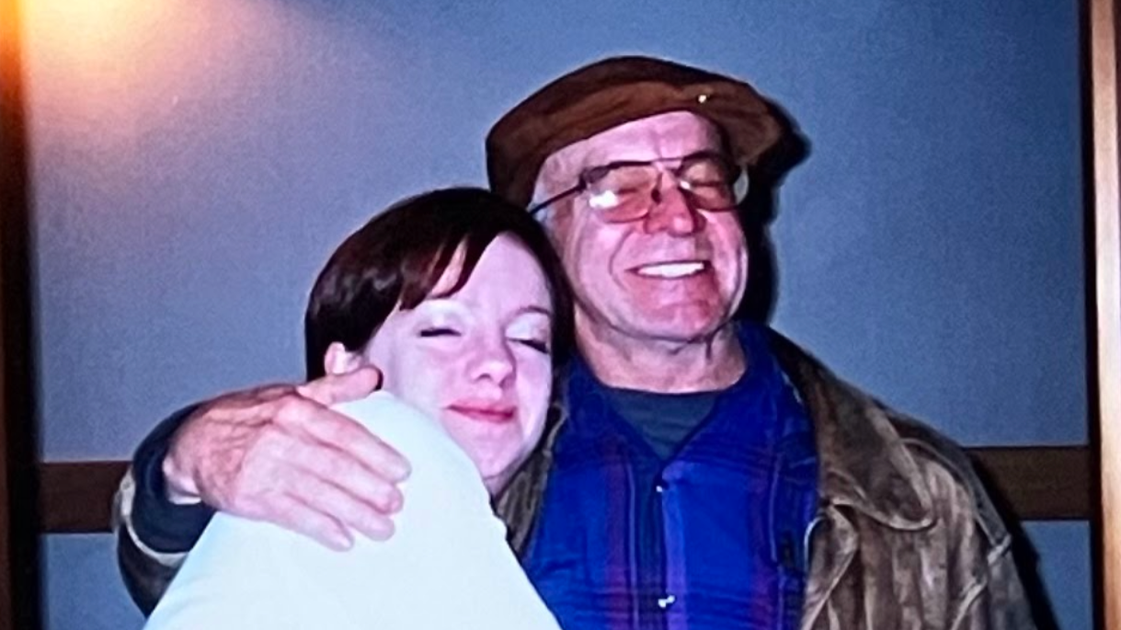
I was onstage, mid-plié, when I saw him enter the auditorium and move toward the front. I didn’t want to be confused with the dozen other 6-year-olds wearing white tights and black leotards, so I immediately straightened up and waved wildly to make sure he saw me.
Read more A Stranger Claimed My Grandpa Was Haunting Her House. The Details Were Too Eerie To Ignore.
“Hi, Daddy!” I exclaimed — the low, awkward laughter from the audience catching me off guard. Suddenly, I felt too exposed.
I lived for semimonthly visits with my dad. He was my knight in dusty armor who wore a cowboy hat, drove a Chevy van, and lived in Oakland, 28 miles away from where my mom and I shared a small basement apartment in Vallejo, California.
I would often sit outside with my Barbie suitcase, at the top of the steps leading down to our apartment, so I would be the first to know when he arrived.
It annoyed my mom, who scoffed while warning me, “You know he runs on Perry time,” referring to his habit of almost always arriving two hours later than he promised.
My parents divorced when I was 3 but still had a lot in common — drugs, alcoholism, child neglect. Nonetheless, I always expected my dad to rescue me. Maybe because his rarity made him seem like the better parent, or because the hero always rescued the princess, or because — unlike my mom — he was a happy drunk.
Looking back, I can count on one hand the number of soccer games, science fairs, and parent-teacher conferences he attended, but the compensatory shopping hauls, carnival visits, and donuts for dinner always helped.
Then, when I was 15, he finally came for me.
I was a theater kid, obsessed with the popular ’80s TV show “Fame.” When my eighth-grade drama teacher told me about a performing arts high school in San Francisco, just a 30-minute train ride from my dad’s house across the bay, I recognized it as my ticket out.
Somehow, I managed to convince my dad to take me in, and my mom to let me go. After successfully auditioning for the School of the Arts, I packed my stuff, said goodbye to my childhood friends, and broke up with my first love.
But sharing a home with my childhood hero was nothing like I’d imagined. We mostly lived like roommates, and I hated being left alone on weekends when he drove out to the Central Valley to build his dream home.
Then, less than a year after I arrived, my dad’s long-term girlfriend married someone else. He lost his job as a career electrician and started drinking more than ever. As my life outside our home took off, his was imploding. He became angry and depressed, and he no longer resembled the happy drunk of my childhood.
Before I knew it, I was living with the same fear, anxiety, and hypervigilance that marked life with my mom. I couldn’t help but wonder what I’d done to deserve it.
The week after my 18th birthday, with five months left to go in my senior year of high school, my dad threw a glass of whiskey at the wall behind me, and stood over me, forcing me to clean it up. When he passed out on the couch, I locked myself in the bathroom and threw up.
The next day, while he was out looking for a job, I tossed my clothes, stuffed animals, and school books into my car and headed to my best friend’s house. I spent the next several months couch surfing until I graduated, got a full-time job, and rented my first apartment in San Francisco.
For the next 20 years, I moved in and out of my dad’s life, always ashamed of returning after he forgot my birthday, or called me a bitch, “just like your mom.”
In the meantime, I repeated the patterns I learned in childhood: abandoning myself, following men I should have run from to other states, relinquishing opportunities I worked hard for, and convincing myself that proving my devotion would finally earn me the love I so desperately craved.
Watching my dad disappear into drugs, alcohol, and a revolving door of people who took advantage of his loneliness was excruciating. I tried to relieve my guilt by reminding myself that he couldn’t even tell you what field I studied in college.
Eventually, I became consumed with litigation when my children’s father sued me for full custody of our daughters, ages 3 and 6. He was ultimately unsuccessful, but the damage was done. I was bankrupt, on public assistance, and lost the only home I’d ever owned to foreclosure.
When I heard that my dad had twice fallen down his stairs, one time requiring a medevac helicopter to the nearest hospital, I begged him to move to Seattle, imagining that this was what would finally bring us together. I promised him Sunday family dinners and a chance to be in his granddaughters’ lives.
It wasn’t enough.
When he repeatedly pressured me to bring the girls and move to his home in the middle of nowhere — promising to pay for everything we would ever need — I explained that they were legally obligated to remain in Seattle, and I would never leave them. He kept asking, and I assumed he was being the same oblivious dad I’d always known. It didn’t occur to me until it was too late that it might be a sign of dementia.
Read more Fort Hood Survivor Responds To Hegseth’s Plan To Livestream Firing Squad Execution
Three years later, when my cousin called to say I should “come now” if I wanted to see my dad before he died, I dropped everything and grabbed the next plane.
I was shocked at what I found. The man who’d defiantly stood up to any challenge and never backed down from a bar fight, was wrinkled, shrunken and confined to a hospital bed, his ability to speak nearly gone.
In a whisper I could barely hear, he asked, “I was a good dad, right?”
Wanting it to be true as much as he did, I responded immediately.
“Of course you were, Daddy, you were such a good dad.”
Three days later, he was gone.
While at his bedside, I learned that his dream home was at risk and would require significant legal action to try to keep it in our family. Even then, there were no guarantees.
I didn’t hesitate and immediately jumped into action. If I couldn’t save him in life, I would save what was left of him.
I called lawyers, borrowed money to pay them, and gave my children’s father additional custody time so I could focus on my mission. The deeper I dug, the more hopeless it became, but I kept going.
When the attorney I hired said the estate wasn’t worth what it would cost to try to save it, I hung up on him and searched for a new one. If I had to, I would do it myself.
I had already represented myself successfully in one court battle. I would do it again.
Then I attended a free legal clinic about how to file your own motions. As I sat there taking copious notes, hanging on the instructor’s every word, he asked a question that changed everything.
“Do you want a good court case or a good life? You can’t have both.”
It felt like a punch to the gut.
When I woke up the next morning, the answer was there waiting for me.
I knew from experience what a protracted legal battle would cost, and not just financially.
If it were just me, the answer might not have been so clear. But my daughters were waiting for me, and I knew I couldn’t save us all.
I packed my stuff, said goodbye to our family heirlooms, and drove back to Seattle, leaving my dad’s dream home in my rearview mirror.
After spending my entire life believing love was something I had to earn — from my dad, other men, or anyone whose approval felt just out of reach — I finally realized it was time to stop performing.
It hasn’t been easy. Six years later, I still sometimes find myself slipping into that old role, confusing self-sacrifice with love and approval with self-worth.
But thinking about my girls always helps bring things into focus, reminding me that none of us has anything to prove.
When I recall my dad’s question now — “I was a good dad, right?” — I think he probably wasn’t asking for reassurance as much as absolution, and I don’t regret my answer, even though it was a lie. His deathbed wasn’t the time to litigate our relationship; it was about offering comfort to a dying man. I know he loved me. It wasn’t enough, and it shaped the course of my life for nearly 50 years.
I also realize that the question he asked as he faced death was much like the one I’ve always faced in life — both of us looking for someone else to tell us we were worthy.
It took decades, but the little girl at the top of the steps has finally realized that she’s always been enough.
Amber Campbell is an essayist, storyteller and narrative strategist. She helps women turn raw personal experiences into compelling stories that create connection, visibility and opportunity. In her weekly letter, Reclamation, she explores story, identity, reinvention, and how to get noticed without losing your dignity. Her work has appeared in Business Insider, BuzzFeed, Scary Mommy, Thrillist, Next Avenue and other publications.
Do you have a compelling personal story you’d like to see published on HuffPost? Find out what we’re looking for here and send us a pitch at [email protected].
Read more Christa Pike Discharged From Hospital, Trump Complains About Nobel Peace Prize Snub: Live Updates








Leave a Reply