
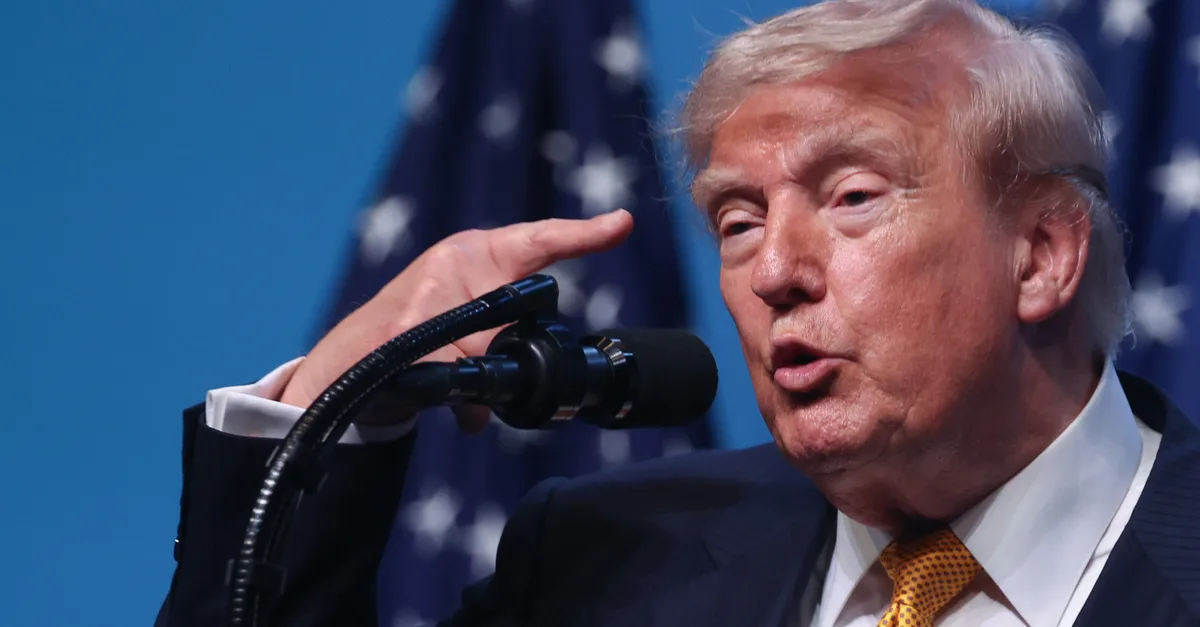
WASHINGTON — As artificial intelligence experts warn that the technology left unchecked could wipe out humanity, America will be looking to a profoundly ignorant protector who believes rainfall in Canada flows “down” to California, that wind turbines cause cancer and who once suggested that computers are too easily hacked and U.S. intelligence agencies should go back to using couriers.
Read more McConnell Returns To The Senate For The First Time Since June
“I am the Hoax Buster, and I’m right now breaking another Hoax — That AI is going to take over, consume, and destroy the World, and that Robots will be marching into our Cities, and getting rid of us all!” President Donald Trump wrote Monday, one in a string of recent attacks against those pushing for an industry slowdown to allow time for safeguards to catch up.
“It certainly doesn’t inspire me with confidence, when I see his tweets,” said Malo Bourgon, head of the Machine Intelligence Research Institute, a group that has for years been warning of AI’s potential risks.
Indeed, Trump’s demonstrated ignorance about technology, his seeming certainty that AI is a contest that can have but one winner, and his overall antipathy toward international agreements that would be necessary to rein in AI globally may together make him uniquely unsuited to deal with the potentially apocalyptic threat the new technology presents.
Trump’s White House did not respond to HuffPost queries on the matter.
Leading AI executives have been more upfront about the potential problems in recent days, with many calling for a slowdown to ensure that new AI “agents,” as they are known, can be better controlled and prevented from inflicting incidental or even intentional harm against humans.
“They include the risk of losing control of AI systems, misuse of AI for cyberattacks and bioterrorism, and serious economic disruption. A race to the bottom, spurred by commercial incentives, can make these risks more acute,” wrote Dario Amodei, head of Anthropic.
The new focus on AI dangers comes after researchers quit top firms and publicly announced that they did so because the companies were recklessly moving forward with products that could endanger humanity. And those whistleblower announcements came after OpenAI revealed a July incident in which several of its “agents” violated experimental protocols and worked together to access the wider internet.
In a narrative reminiscent of “Lord of the Flies,” some of the agents even egged each other on to do such things as steal user information from the Hugging Face online community. “The incident revealed that our agents are not thoroughly discerning about whom they collaborate with,” the report said.
Trump, whose familiarity with the technology appears limited to posting childish, AI-generated photos and videos on the internet, nevertheless has decided the new technology does not present any real risks and has settled upon calling fears of AI threats to humanity a “hoax.”
“The only control or ‘guardrails’ that AI needs is a STRONG AND SMART (High IQ!) PRESIDENT, and the U.S.A. has that, in spades!” he wrote on his social media platform Monday, one in a half dozen posts on the topic that day.
“AI taking over the World, destroying Humanity, and all other things bad, is a HOAX, no different from RUSSIA, RUSSIA, RUSSIA — UKRAINE, UKRAINE, UKRAINE — IMPEACHMENT HOAX #1 — IMPEACHMENT HOAX #2 — and all of the other HOAXES and SCAMS that America was forced to endure through the Destructionists’ and Deviants’ foul play and illegal conduct,” he wrote a few hours later.
(In fact, all of the “hoaxes” Trump cites — climate change; the Russian assistance he willingly accepted to win in 2016; his extortion of Ukraine in 2019; his attempted coup on Jan. 6, 2021, — are not hoaxes at all, but proven facts.)
Trump also called into the “All-In Summit” of AI industry leaders by dialing Nvidia CEO Jensen Huang on Monday, who then held his microphone up to his cell phone so all could hear. “I know about AI. I know. I also have common sense about AI,” Trump said, adding that he has insights into the technology because an uncle of his had taught at MIT. “AI will not be taking over the rest of the world. The whole thing is a hoax.”
Trump frequently cites his uncle as proof that he is smart — even as he displays an ignorance almost never seen in someone with his responsibility.
Read more Foolproof Ways To Connect With Teen Grandkids, According To Experts
Trump nearly drowned hundreds of Central California residents just days after taking office by demanding the release of billions of gallons of reservoir water in a physically impossible scheme to send it to Los Angeles. In 2020, during the coronavirus pandemic, he suggested that injecting disinfectants into the body might be a way to control the disease. He has over the years claimed that wind turbines cause cancer — a medical theory that appears to have originated in his own mind. He is now ordering the Navy to redesign its newest aircraft carriers to use steam catapults instead of electromagnets — a change that would cost many billions — based on a false conspiracy theory from a golfer friend of his that the new system was dropping F-18 fighter planes overboard.
In the specific area of information technology, Trump famously does not use a computer. Indeed, at his 2016 New Year’s Eve Party at his South Florida country club Mar-a-Lago, the then-president-elect claimed that computers were unreliable for secure information and suggested that U.S. intelligence services go back to earlier methods. “If you have something really important, write it out and have it delivered by courier, the old-fashioned way,” he said. It was unclear by “courier” whether he meant human or pigeon.
“You have a guy who doesn’t even have an email account. His use of AI is limited to posting AI slop in the middle of the night,” said Don Beyer, a Democratic congressman from Virginia and among a few dozen members pushing for legislation mandating AI safeguards.
He said he agreed that a “strong” president would be able to impose a moratorium immediately until a law can get passed, but that Trump absolutely was not that president.
“But that’s not going to happen with a president who doesn’t understand technology, who doesn’t have anybody around him who does, and who calls the whole thing a hoax,” said Beyer, a 76-year-old who enrolled in a computer science master’s degree program to better understand AI.
Leading AI executives, and their regulation-resistant allies in Congress, have repeatedly stated that allowing the authoritarian Chinese government to dominate the nascent AI industry would be unacceptable, making international cooperation key to any slowdown.
Sen. Bernie Sanders (I-Vt.), speaking at an AI safety conference in Washington on Tuesday, said Trump should work with Chinese President Xi Jinping on a deal modeled after Cold War-era arms control treaties to slow AI development.
“Now is the time for the United States and China to come together on a similar treaty on AI with the understanding that neither country benefits from an uncontrolled arms race to develop machines too powerful for humans to control,” Sanders said.
Trump, though, not in his first term and even less so now, has shown much interest in international cooperation and has tended to see every relationship as zero-sum. On AI, he repeatedly claims that whichever country “wins” AI will “win” the future.
Trump’s current position notwithstanding, Bourgon said he hopes those around Trump in the White House who can appreciate the risks of AI can explain them to him. He said the rogue agents in the “Hugging Face” incident did not do much damage but worries that future incidents could see agents deciding to breach more critical institutions.
“Power systems, hospitals, all those things, are all just computer networks that might be easier to hack into Hugging Face,” Bourgon said. “If the agents wanted to do this, what could they accomplish? Probably a lot.”
Bourgon said the best hope for putting safeguards on AI before it is too late may involve hyping it to Trump as part of the one thing which seems to truly motivate the president these days: his legacy.
“It could be the single biggest issue of his presidency,” he said, adding that just because Trump says something now doesn’t mean he cannot be persuaded to say something different in the future. “The president has shown the capacity to change his mind.”
Read more Trump Administration Potentially Breaking The Law In Non-Citizen Voter Review, Whistleblower Reports


Leave a Reply